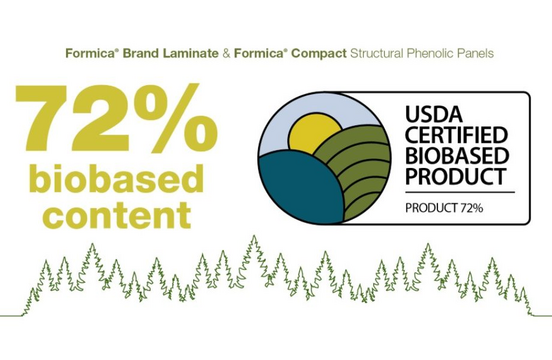
What Is the USDA’s BioPreferred Program?
Launched in 2002, the USDA’s BioPreferred Program focuses on increasing the prevalence of biobased products in the market. Biobased materials are derived from plants or other renewable sources versus nonrenewable petroleum-based products. The environmental impact of biobased offerings includes the ability to sequester carbon dioxide, which is important for reducing greenhouse gases in the atmosphere.
Transparency in Testing and Results
Formica Group offers a variety of grades (thicknesses) of standard Formica® Brand Laminate (including 180fx® Laminate) as well as Formica® Brand Compact Panels for different applications. Furniture, countertops, wall coverings, and other use cases all require specific levels of durability in the form of a thicker sheet or panel. Thicker products are made with a thicker core layer, which is where the majority of the product’s biobased content is contained in the form of wood fibers. In addition, each décor layer, the outward-facing pattern, also incorporates a different quantity of paper fibers, which in turn affects the item’s level of biobased material.
Formica Group took the approach of assessing the biobased content in our products using the thinnest option for both Formica® Brand Laminate and Formica® Compact Panels. In this way, we know related products have a similar or higher amount of the bio-rich core layer. This underscores our commitment to transparency not only in the results we share, but also in the details of how we approached the certification and testing process.
Formica Group’s Commitment to Sustainability
From our sample recycling program to our renewable energy practices, Formica Group is proud to evolve our business practices and look at everyday processes in new ways to help reduce our global impact. We are committed to reducing our carbon footprint, energy and water usage, and identifying new and better ways to bring our signature products to market with sustainability at every turn.